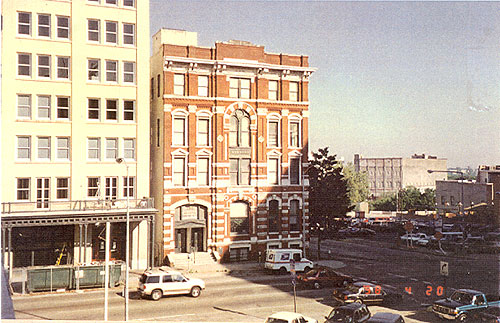
The following is an account of my involvement in Century Development Corporation's attempt to acquire the Techman Land in Phase IV of Greenway Plaza. This land acquisition was conducted in conjunction with Mobil Oil's option to purchase land in Greenway Plaza, Phases III and IV, in 1980.
Tejas Power Corp. Helps Fill BP Plaza
The Houston Post/Sunday, April 25, 1993
FROM STAFF REPORTS
Tejas Power Corp. has leased 30,107 square feet of space in the newly constructed BP Plaza located at 200 West Lake Boulevard in the Energy Corridor's West Lake Park complex.
Robert Orkin, of Robert Orkin Interests Inc., represented the lessee, while Mark Sutton of BP Exploration Inc., Tim Relyea of Cushman Realty Corp., and C. Dean Patrinely of Barker-Patrinely Group Inc. represented the lessor, Central Tract Limited. BP Plaza was developed and is managed by Barker-Partrinely.
BP Exploration occupies most of the 20-story tower. Now, the addition of Tejas, and earlier lease deals with Equitable Resources and Amax Energy, bring BP Plaza up to 100 percent occupancy. The tower was completed in December.
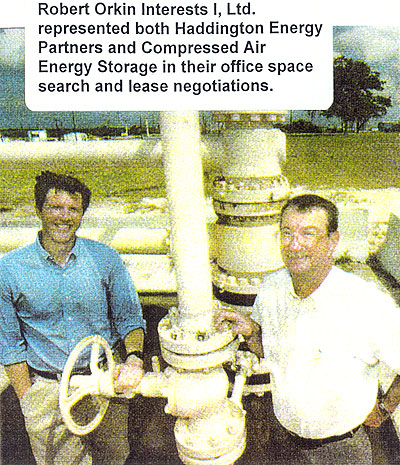
Ridge CEO Dine Glascow (left), with President Rodney Webb: 'We think compressed air energy storage is an ideal application in today's market'
Pumping-up Power
Competing Firms Spring Up to Store Electricity in Caverns Underground
By Monica Perin
Houston Business Journal
Dine Glascow is taking on one of the power industry's most nagging problems-with little more than hot air.
Glascow says his Houston company, Ridge Energy Storage, has a highly marketable solution to the wide fluctuations in demand for electricity by pumping compressed air into limestone caverns within the Earth's crust.
And Ridge Energy isn't alone. While it is negotiating an underground site in east Harris County, Houston-based Haddington Energy Partners also is laying plans to store excess energy in Ohio.
"We think compressed air energy storage is an ideal application in today's market, with its clear pricing signals on an hourly basis and open access to transmission," Glascow says. "We think it is going to be a very big deal."
SCOUTING SITES
Because electricity generally can't be stored, it is typically produced and delivered on demand. And demand fluctuates considerably between day and night, summer and winter. When temperatures soar so does demand for electricity – and so does its price in the deregulated U.S. market.
But generating plants that are already producing power at capacity can't produce more to meet peak demands, nor can they cut back efficiently when demand drops. So utilities must often buy extra power from other suppliers at inflated prices to meet peak demands while selling off their excess power at low prices during low demand periods.
Ridge Energy and Haddington Energy each are poised to use their alternative way of providing electricity to meet peak demands and deal with that volatile power market prices.
The companies plan to use cheap nighttime electricity to store compressed air in underground caverns. During the day, when the price of electricity goes up, the compressed air will be released through turbines to create electricity.
The process, known as compressed air energy storage (CAES), is more than 20 years old. But only two such plants currently exist in the world – a nine-year old facility in McIntosh, Ala., about 40 miles north of Mobile, and a 22-year old plant in Germany.
Last October, Houston-based Haddington Energy's Compressed Air Energy Storage Development Group paid $1 million for storage rights to a 338-million cubic-foot limestone mine in Norton, Ohio. And last month the company signed an agreement with the city of Norton to build a compressed air power plant on the site of the limestone mine and use the mine for storage of compressed air.
A separate subsidiary, Norton Energy Storage, which will develop and operate the plant, is now seeking approval of the project from the Ohio Power Siting Board.
The $100 million proposed power plant would initially produce from 130 to 270 megawatts of power. With up to four additional phases on the drawing board, the Norton plant could produce 10 to 20 times more power than the Alabama plant does.
Meanwhile, Ridge Energy Storage of Houston plans to begin building its first compressed air energy storage plant by the end of this year here on the Gulf Coast and anticipates having seven plants totaling more than 2,000 megawatts of power in operation or under construction by the end of 2004.
Ridge Energy has acquired exclusive rights to six sites in Texas and Louisiana, with negotiations underway on several more in the Midwest and West and one site in England.
Ridge Energy plans to use salt caverns, like the Alabama plant, for its projects because the company's founders believe these formations are better than others for this purpose.